Imagine walking through the sun-warmed streets of Agadir just days after Eid al-Adha. The air still carries the lingering warmth of communal feasts, and the city hums with a particular kind of anticipation something ancient is about to stir. Then, from a narrow alley near the old medina, a procession of extraordinary figures emerges: performers draped in animal skins, faces hidden behind haunting hand-carved wooden masks, moving through the crowd in rhythmic, almost trance-like steps. Drums beat. Women ululate. Children shriek with delight. You have just witnessed Boujloud in Agadir one of Morocco’s most electrifying, deeply rooted, and hauntingly beautiful cultural traditions.
For curious travelers, cultural enthusiasts, and anyone who wants to experience authentic Morocco beyond the postcard images, the Boujloud festival is an unmissable window into the soul of Amazigh civilization. This is not simply street theater. It is living history, costumed mythology, and community celebration woven together into one extraordinary spectacle.
For more information about Agadir, including where to stay, the best things to do, how to get around, and practical travel tips, check out our complete Agadir Travel Guide. Agadir Travel Guide
What Is Boujloud or Bilmawen?
At its most essential, Boujloud also known as Bilmawn is a traditional Moroccan festival celebrated in the days following Eid al-Adha, the Islamic Festival of Sacrifice. The name itself is evocative: “Boujloud” roughly translates from Amazigh as “father of skins” or “master of hides,” a direct reference to the animal skins that define the costume at the heart of the celebration.
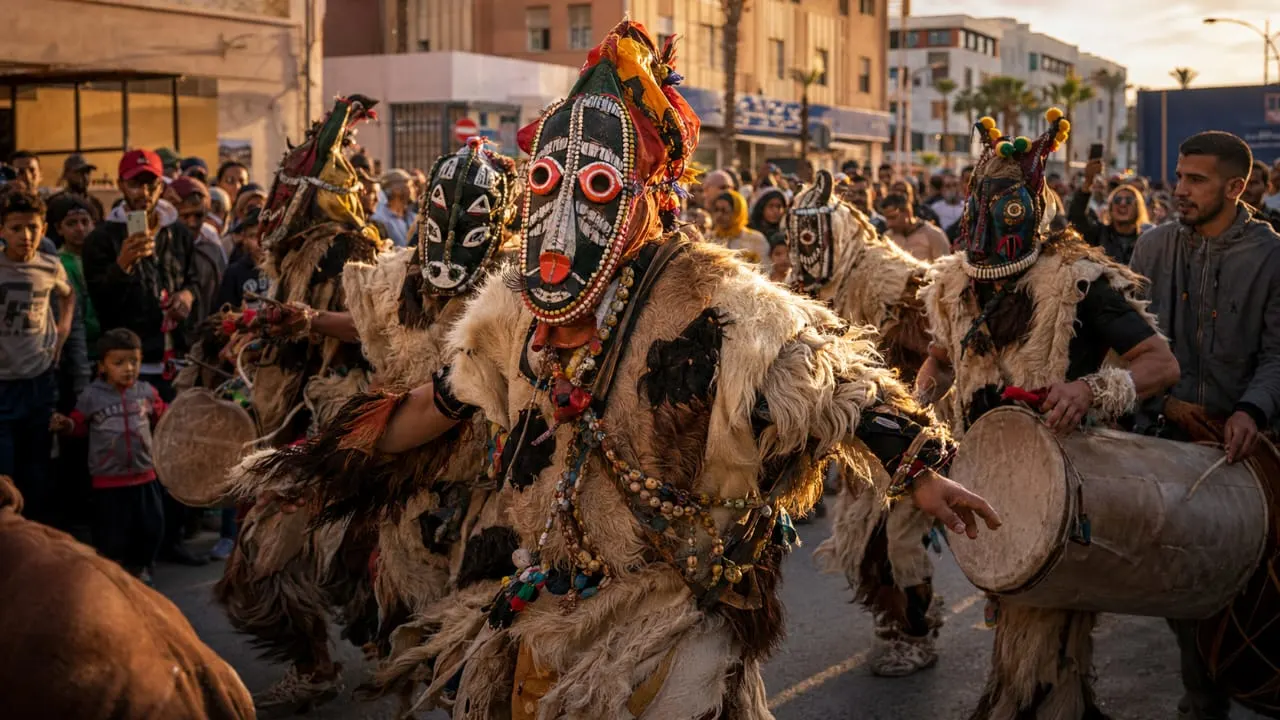
The central figure of Boujloud is a performer traditionally a young man who dresses in the freshly slaughtered sheep or goat skins from Eid al-Adha sacrifices, adorning himself with a carved mask, horns, and colorful decorations. He moves through neighborhoods in a procession accompanied by musicians, dancers, and jesters, blessing homes, entertaining crowds, and embodying a spirit that bridges the human and the supernatural.
Unlike formalized state festivals, Boujloud has always been a grassroots, community-led celebration organic, exuberant, and deeply tied to the land, the seasons, and the people who have inhabited the Souss-Massa region of Morocco for millennia.
The Origins of Boujloud in Morocco
The origins of Bilmawen Morocco stretch back far beyond Islam deep into the pre-Islamic Amazigh world of North Africa. Scholars of Moroccan folklore and cultural anthropology trace Boujloud’s roots to ancient agricultural and pastoral rituals practiced by the Imazighen (Berber) peoples across the Atlas Mountains and the southern plains.
In its earliest form, the tradition was likely tied to seasonal fertility rites a post-harvest or post-sacrifice ritual designed to ward off evil spirits, ensure prosperity for the coming year, and honor the bond between human communities and the natural world. The figure of the man dressed in animal hides terrifying yet playful, sacred yet comic appears across dozens of world cultures, from European carnival traditions to Sub-Saharan African masquerades. In Morocco, this archetype found its home in Boujloud.
Over centuries, as Islam spread across the Maghreb and became interwoven with Amazigh identity, Boujloud evolved. The timing shifted to coincide with Eid al-Adha logistically convenient, since skins were abundant and the ritual absorbed new layers of Islamic cultural meaning. Yet its pre-Islamic heart remained beating. Even today, Boujloud exists in a fascinating cultural space: neither purely Islamic nor purely pagan, but something uniquely, irreducibly Moroccan.
Boujloud and Amazigh Culture in Souss
Nowhere in Morocco is Amazigh culture more proudly and visibly alive than in the Souss-Massa region, of which Agadir is the undisputed capital. The Souss is the heartland of the Tachelhit-speaking Amazigh people one of the three major Berber linguistic groups of Morocco and their cultural inheritance is extraordinarily rich: from the poetry of the imdhiyazen (traditional bards) to the architectural beauty of tighremts (fortified granaries), from the silver jewelry of the Anti-Atlas to the thundering rhythms of Ahwach and Taskiwin music and dance.
Within this landscape, Boujloud Agadir holds a place of special importance. The tradition here is not a tourist re-enactment or a museum piece it is a living practice passed down through generations of Soussi families. Elders teach the younger generation how to prepare the costumes, carve the masks, and perform the specific movements that distinguish a true Boujloud procession from mere imitation.
The Amazigh celebrations surrounding Boujloud in the Souss also serve a deeply social function: they mark the transition between the solemnity of Eid a deeply religious occasion and a return to communal joy, music, and laughter. After days of prayer, family visits, and shared meals, Boujloud is the great release, the carnival spirit that reminds communities that life is to be celebrated.
How Agadir Celebrates Boujloud After Eid al-Adha
In Agadir, Boujloud celebrations typically begin on the second or third day after Eid al-Adha and continue for several days sometimes stretching across a full week of neighborhood-by-neighborhood festivities. The format is beautifully decentralized: rather than a single grand parade in a central square, Boujloud unfolds organically across different quarters of the city and surrounding villages.
Here is how a typical Boujloud celebration in Agadir unfolds:
- Morning preparations: Families who preserve the tradition spend the morning of the first Boujloud day preparing the skins from Eid al-Adha, treating them with salt and herbs, and helping the chosen performer often a young man from the family or neighborhood dress in the elaborate costume.
- The procession forms: By mid-afternoon, a procession assembles: the Boujloud figure at center, flanked by musicians beating tbel (large frame drums) and bendir (shallow frame drums), as well as friends and family members who accompany him through the streets.
- Street performances: As the procession moves through neighborhoods, Boujloud performs for gathered crowds running at children who shriek and scatter, dancing for elders who watch with knowing smiles, blessing doorways, and accepting offerings of food and sweets from households.
- Evening celebrations: As sunset approaches and the muezzin’s call drifts over the city, the procession reaches its climax a gathering in an open square or courtyard where musicians, dancers, and the crowd come together for a final, joyous celebration under the stars.
Best Places to Experience Boujloud in Agadir
If you’re planning to witness Boujloud in Agadir, knowing where to position yourself makes all the difference between a fleeting glimpse and a truly immersive experience. Here are the best locations:
The Old Villages Surrounding Agadir
The richest Boujloud traditions are found not in the modern resort city itself, but in the traditional villages and suburbs that form Agadir’s cultural hinterland places like Aït Melloul, Dcheira el Jihadia, Inezgane, and Temsia. These communities have maintained Boujloud practices with more continuity and authenticity than the urban center.
Agadir’s Talborjt Neighborhood
Within the city itself, the Talborjt district the historic heart of old Agadir, rebuilt after the devastating 1960 earthquake is one of the most vibrant places to witness Eid al-Adha traditions Morocco style come to life. Local families here are proud custodians of Boujloud custom.
Souss-Massa Rural Communities
For the most profound experience, consider renting a car and venturing into the Souss plain toward the foothills of the Anti-Atlas. Small agricultural communities here celebrate Boujloud with a rawness and authenticity that is genuinely moving pure Moroccan folklore at its most unfiltered.
Why Boujloud Became a Cultural Tourism Attraction
Over the past decade, Boujloud festival has quietly emerged as one of the most compelling reasons for culturally curious travelers to time their visit to southern Morocco around Eid al-Adha. Several factors have driven this rise in tourism interest:
Authenticity in an age of over-tourism. As more travelers grow tired of sanitized, commodified cultural experiences, Boujloud represents something genuinely unscripted a tradition that exists for the community first and spectators second. That authenticity is magnetic.
Visual drama. The costumes, masks, and movement of Boujloud are extraordinarily photogenic. In an era of visual storytelling on platforms like Instagram and Pinterest, images of Boujloud performances in the streets of Agadir have generated significant international interest.
Timing with Eid al-Adha travel. Many travelers both from the Moroccan diaspora and international visitors already time trips to Morocco around Eid. Boujloud gives the post-Eid period its own distinct cultural identity, extending the appeal of the visit.
Growing Amazigh cultural pride. Morocco’s official recognition of Tamazight (the Amazigh language) as a national language in 2011, and its continued promotion of Amazigh heritage, has created a cultural environment in which traditions like Boujloud are celebrated rather than marginalized.
Traditional Music, Dance & Costumes of Boujloud
The sensory world of Boujloud Agadir is one of its most captivating dimensions. Every element sound, sight, movement carries meaning.
The Costume
The Boujloud costume is built around freshly treated animal skins from Eid al-Adha typically sheep or goat, sometimes camel. These are draped over the performer’s entire body, creating a silhouette that is simultaneously human and bestial. The mask carved from wood, often painted in striking patterns of red, black, and white is perhaps the most arresting element: wide eyes, exaggerated features, sometimes adorned with real horns. No two masks are identical; many are family heirlooms passed down through generations.
The Music
Boujloud processions move to the urgent, hypnotic rhythm of traditional Amazigh percussion: the deep boom of the tbel, the crisp snap of the bendir, and sometimes the haunting cry of the ghaita (a double-reed wind instrument). In the Souss, this music belongs to the same family as the great Ahwach tradition collective music-making that emphasizes communal participation over individual virtuosity.
The Dance
The movement of the Boujloud figure is deliberately stylized a lurching, crouching, darting gait that mimics the movement of an animal while retaining unmistakably human intelligence. Accompanying dancers and musicians move in call-and-response patterns, the crowd clapping and singing along.
Travel Tips for Tourists Attending Boujloud Festival
Planning to attend Boujloud in Agadir? Here’s everything you need to know to make the most of your experience:
- Timing: Boujloud celebrations begin 2–3 days after Eid al-Adha and continue for 3–7 days. In 2026, Eid al-Adha falls in late May/early June check the official Moroccan calendar for the exact date.
- Dress respectfully: Boujloud is a community celebration rooted in faith and culture. Dress modestly, especially when celebrations happen near mosques or in traditional neighborhoods.
- Ask before photographing: Always seek permission before photographing performers or community members. A smile and a polite “shukran” (thank you) go a long way.
- Go local: The best experiences are found by following the sound of drums away from tourist areas and into residential neighborhoods. Don’t be afraid to wander.
- Hire a local guide: A knowledgeable local guide can provide cultural context, facilitate introductions, and help you access celebrations that might otherwise feel closed to outsiders.
- Combine with Agadir’s other attractions: Agadir offers stunning Atlantic beaches, the rebuilt Kasbah hilltop fortress, the excellent Musée Municipal du Patrimoine Amazigh, and the lively souk El Had the largest market in southern Morocco.
Differences Between Boujloud in Agadir and Other Moroccan Cities
While Boujloud is celebrated across Morocco from Fès and Meknès in the north to Marrakech in the center and Tiznit in the deep south the tradition takes on distinctly regional flavors. Understanding these differences helps travelers choose the experience that resonates most.
| Location |
Character |
Notable Feature |
| Agadir / Souss |
Deep Amazigh roots, rural intensity |
Tachelhit language, Ahwach music |
| Fès / Meknès |
Urban, more theatrical |
Elaborate masks, carnival atmosphere |
| Marrakech |
Tourist-influenced, performative |
Often staged for mixed audiences |
| Tiznit / Anti-Atlas |
Raw, traditional, rarely documented |
Most ancient form of the practice |
| Beni Mellal |
Middle Atlas Amazigh flavor |
Tamazight language, distinct music |
What distinguishes Boujloud in Agadir above all is the deep continuity between the urban celebration and its rural roots. Because the Souss remains a living Amazigh cultural heartland not a museum but a community the tradition here feels less performed and more practiced. It is not staged for outsiders; it simply continues, as it has for generations, because it matters.
FAQ About Boujloud in Morocco
When does Boujloud take place in Agadir?
Boujloud celebrations begin 2–3 days after Eid al-Adha and typically last between 3 and 7 days. The exact dates change each year according to the Islamic lunar calendar.
Is Boujloud safe for tourists to attend?
Yes, absolutely. Boujloud is a joyful community celebration. While the costumes can be startling, the atmosphere is festive and welcoming. As with any cultural event, basic respect and cultural sensitivity go a long way.
What does “Bilmawen” mean?
“Bilmawen” is the Arabic-inflected name for the same tradition known in Amazigh as Boujloud. Both names refer to the central figure dressed in animal skins “Bilmawen” derives from Arabic roots meaning “the one with the colors/skins.”
Can tourists participate in Boujloud?
Participation is community-led, but visitors are warmly welcomed as spectators. Some local guides can arrange more intimate experiences with families who celebrate privately.
Is Boujloud only in Agadir?
No Boujloud is celebrated across Morocco, particularly in Amazigh-majority regions. However, Agadir and the broader Souss-Massa region are considered among the most authentic places to experience it.
Is Boujloud a religious festival?
Boujloud has both pre-Islamic Amazigh roots and Islamic cultural layers. Its timing coincides with Eid al-Adha, but its character is more folkloric and communal than strictly religious.
What should I wear to a Boujloud celebration?
Dress modestly and comfortably. Light, breathable layers are ideal for the warm post-Eid climate in Agadir. Comfortable walking shoes are essential for following processions through streets and alleys.
Your Invitation to Agadir and the World of Boujloud
There is a Morocco that exists beyond the polished riads of Marrakech and the Instagram-famous blue walls of Chefchaouen a Morocco of extraordinary depth, where ancient traditions breathe with living vitality, where the drumbeat of a Boujloud procession at sunset can send a shiver down the spine of even the most seasoned traveler. Agadir is the gateway to this Morocco.
Come in the days after Eid al-Adha, when the city is still warm with the spirit of celebration. Follow the drums into the narrow streets of Talborjt or the sunlit plazas of Inezgane. Watch as a young man in animal skins and a carved wooden mask transforms himself and, somehow, transforms you too into something timeless. That is the gift of Boujloud in Agadir: not just a spectacle, but a reminder that the deepest human experiences community, ritual, joy, mystery have always looked something like this.
Agadir is waiting. Book your journey to Morocco and let the tradition of Boujloud be your most unforgettable travel memory.