Morocco Traditional Clothing: Complete Guide
Traditional Clothing of Morocco: The Complete Tourist Guide Morocco is a country where clothing tells a story. Every robe, slipper, and headscarf carries centuries of...
📍 Part of: The Complete Morocco Travel Guide
If Marrakech is Morocco’s gateway to adventure, Ouarzazate and Merzouga are where that adventure reaches the desert. Known as the Gateway to the Sahara and nicknamed the Hollywood of Africa for its decades of film production Ouarzazate sits at the edge of the Sahara, on the route toward Merzouga’s golden dunes at Erg Chebbi.
This guide covers the route between these two destinations, what to see along the way, and how to plan a Sahara desert trip from start to finish.
Ouarzazate sits south of the High Atlas Mountains, about 4 hours from Marrakech by road over the Tizi n’Tichka pass one of Morocco’s most scenic mountain drives. From Ouarzazate, the route continues roughly 480 km further to Merzouga, on what’s often called “the road of a thousand kasbahs,” passing through the Dades and Todra Gorges, the rose-growing Dades Valley, and the long palm groves of the Draa Valley.
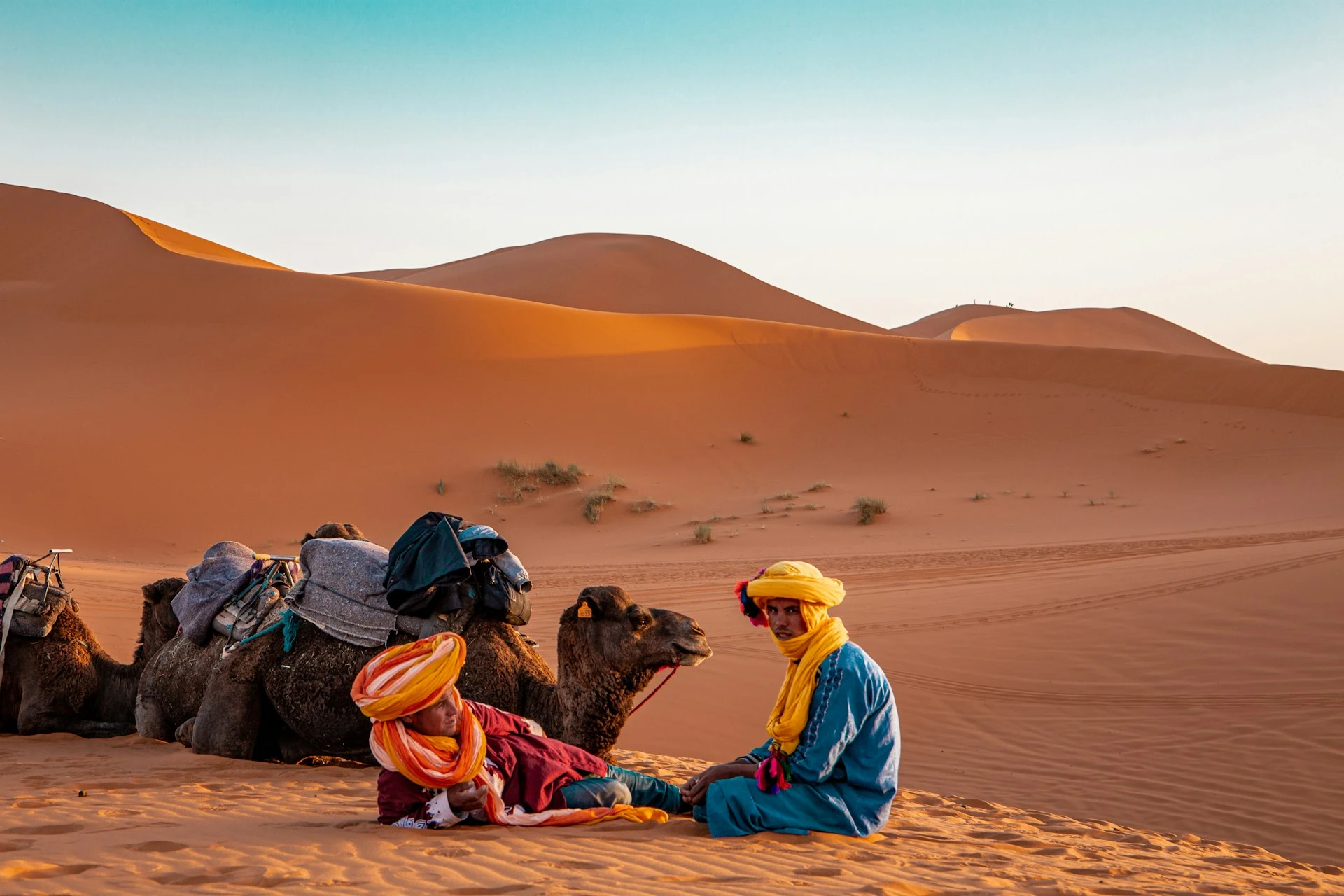
Merzouga itself sits at the edge of Erg Chebbi, one of Morocco’s most famous Sahara dune fields towering golden dunes that are the centerpiece of nearly every Morocco desert tour.
From Marrakech to Ouarzazate (~4 hours): The most common route, crossing the High Atlas via the Tizi n’Tichka pass a dramatic mountain drive in itself, with stops often made at Ait Benhaddou along the way. Buses, grand taxis, and private transfers all run this route; Ouarzazate also has a small airport with limited flights.
From Ouarzazate to Merzouga (~5-6 hours, ~480 km): Most travelers cover this as part of a multi-day desert tour rather than as a standalone transfer, since the route itself through the Dades Gorge, Todra Gorge, and Draa Valley is a major part of the experience.
Multi-day tours from Marrakech or Fes: The most popular way to experience this region is a 2-3 day organized desert tour, typically Marrakech → Ouarzazate → Dades/Todra Gorges → Merzouga (overnight in the desert) → return to Marrakech or onward to Fes. This lets you see the full route without the logistics of independent travel.
Spring (March-May) and autumn (September-November) offer the most pleasant conditions for both Ouarzazate and the desert comfortable daytime temperatures and clear skies, ideal for sightseeing and overnight camps.
Summer (June-August): Very hot, often exceeding 40°C (104°F), especially in Merzouga and the desert. Midday activities become uncomfortable; tours typically shift activities to early morning and evening.
Winter (December-February): Cool, clear days but cold nights especially in the desert, where temperatures can drop sharply after sunset. A warm layer is essential even if the daytime feels mild.
Ouarzazate’s identity is shaped by two things: its film history and its position as the threshold to the desert.
For the full list of attractions in and around Ouarzazate, see 10 Unmissable Places to Visit in Ouarzazate
The journey from Ouarzazate to Merzouga is as much the destination as Merzouga itself:
For those seeking something more remote, Erg Chigaga (reached via Zagora) offers a less-visited alternative to Erg Chebbi, with fewer crowds.
In Ouarzazate: A mix of budget guesthouses, mid-range hotels, and small riads near the town center, convenient for film studio visits and as a stop before continuing toward the desert.
In Merzouga: Desert camps are the highlight ranging from simple Berber-style tents to luxury camps with private bathrooms, set among the dunes of Erg Chebbi. An overnight desert camp is considered an essential part of the experience, usually included in multi-day tours from Marrakech or Fes.
Most travelers book a 2-3 day organized tour that crosses the High Atlas via Ouarzazate, continues through the Dades and Todra Gorges, and ends with an overnight camp in the Sahara at Merzouga, before returning to Marrakech or continuing to Fes.
Yes beyond being a stop on the way to the desert, Ouarzazate has its own attractions, including the Atlas Film Studios, Kasbah Taourirt, and the nearby UNESCO-listed village of Ait Benhaddou.
A 2-3 day tour from Marrakech is the standard, allowing time for the scenic drive through the Atlas Mountains and gorges, an overnight camel trek and desert camp at Erg Chebbi, and either a return to Marrakech or onward travel to Fes.
Erg Chebbi is the famous dune field near Merzouga, with golden dunes reaching up to 150 meters the classic image of the Sahara and the centerpiece of most Morocco desert tours.
Spring (March-May) and autumn (September-November) offer the most comfortable temperatures for both the journey and overnight desert camps. Summer can exceed 40°C, while winter nights in the desert are cold despite mild days.

Traditional Clothing of Morocco: The Complete Tourist Guide Morocco is a country where clothing tells a story. Every robe, slipper, and headscarf carries centuries of...

The top places to visit in Ouarzazate include Ait Ben Haddou (UNESCO World Heritage Site), Taourirt Kasbah, Atlas Corporation Studios, the Dades Valley, and Draa Valley
